Lee's First Visit to Beijing: A Balanced Restoration of Sino-South Korean Ties
Lee's First Visit to Beijing: A Balanced Restoration of Sino-South Korean Ties
09/01/2026
Diplomacy and Public Affairs
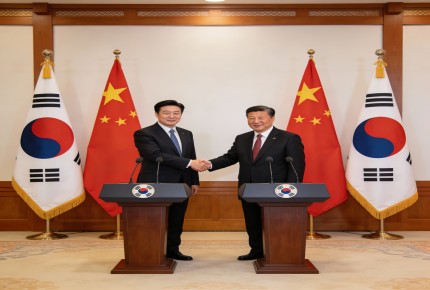
After meeting with President Xi Jinping on his first visit to Beijing since taking office in June, South Korean President Lee Jae Myung stated on Monday that he wanted to begin a 'new phase' for relations with China.
According to Lee, “this summit will be an important opportunity to make 2026 the first year of full-scale restoration of Korea-China relations. I believe that efforts to develop the strategic cooperation and partnership between the two countries into an irreversible trend of the times will continue.”
Lee's second meeting with Xi in two months indicates China's strong interest in enhancing economic collaboration and tourism with Seoul, especially as relations with Japan have deteriorated over Taiwan policy disputes.
Xi Jinping's Call for More Collaboration in Northeast Asia
In remarks reported by Xinhua, China's state-run news agency, Xi Jinping highlighted the common experiences of China and South Korea in resisting Japan during World War II, stating, “More than 80 years ago, China and South Korea made tremendous national sacrifices and won the victory against Japanese militarism.”
Xi went on to say that the two nations should “safeguard peace and stability in Northeast Asia.”
Notably, North Korea blasted at least two ballistic missiles, its first in two months, just hours before the visit. Pyongyang must continue to have a potent nuclear deterrent, according to leader Kim Jong Un.
As stated by Wi Sung-lac, security adviser to Lee, following a meeting with Xi, South Korea and China emphasised the need to resume dialogue with North Korea and agreed to seek innovative approaches to reduce tensions and promote peace on the Korean Peninsula.
North Korea: Strategies for Reducing Tensions
Lee, elected in June, aims to strengthen U.S. ties while avoiding antagonism with China and reducing tensions with North Korea.
Meanwhile, Beijing has been pursuing closer relations with Seoul following a split with Japan, particularly after Prime Minister Sanae Takaichi indicated in November that Tokyo might consider military action if Beijing were to attack Taiwan.
Xi stressed the need for China and South Korea to make sound strategic decisions amid a “chaotic and complicated international situation.” He urged both nations to prioritise each other's core interests and resolve differences through dialogue and consultation.
Besides, Seok Byoung-hoon, a professor at Ewha Womans University, indicated that Xi’s remarks imply China desires Seoul to align more with Beijing than Washington on cross-Strait relations with Taiwan and to acknowledge Beijing's stance on the U.S. action against Venezuelan President Nicolás Maduro.
Key Areas of Collaboration
The two countries signed 15 agreements at the summit, covering technology, intellectual property, and transportation cooperation.
Chinese and South Korean companies signed nine cooperation agreements during a state visit by Lee, accompanied by over 200 South Korean business leaders, according to South Korea’s Trade Ministry. Among the companies involved are Alibaba International, Lenovo, and Shinsegae.
Lee underlined the necessity for South Korea and China to enhance economic collaboration in artificial intelligence and suggested potential cooperation in consumer goods and cultural content. However, Kang Hoon-sik indicated that Beijing is unlikely to soon lift its unofficial ban on Korean culture.
Furthermore, Lee took a selfie with the presidential couples, including a smiling Xi, at a state banquet in the Great Hall of the People, using a Xiaomi smartphone.
During a state visit to South Korea late last year, Xi offered Lee the phone and joked that he should “check if there's a backdoor.”
“The image quality is certainly good, right?” Lee said in a social media post with a happy face emoji.
“Thanks to you, I got the picture of a lifetime haha,” he posted.